AI is no longer a futuristic add‑on for IT teams. It is becoming a core engine that powers modern ITSM AI, helping organizations deliver faster support, lower costs, and better digital experiences for employees and customers alike. By improving customer support with AI and understanding why businesses need AI in call centers, organizations can move from reactive ticket handling to proactive, predictive, and highly automated service delivery. This is the essence of ITSM AI – a smarter, data‑driven way to run IT services.
Expanding IT capabilities with intelligent tools has become essential in modern business landscapes. Organizations exploring high-performance computing solutions for small businesses often find that combining these systems with ITSM AI creates seamless workflows and faster problem resolution. Similarly, enterprises are leveraging insights from advanced supercomputing technology trends to anticipate IT incidents before they impact employees or customers.
For companies aiming to strengthen customer engagement, integrating ITSM AI with effective marketing strategies can be transformative. Platforms like Marketing for Customers strategies that improve engagement provide actionable insights to help service teams respond smarter and faster. Likewise, staying updated on marketing automation techniques for IT service teams ensures that digital touchpoints remain consistent and personalized.
Financial planning also benefits from AI-driven ITSM. By aligning service management data with top financial resources for IT departments, decision-makers can forecast budgets more accurately, reduce unnecessary expenses, and prioritize investments that directly enhance customer satisfaction. Over time, these combined efforts enable a business to run smoother, reduce downtime, and foster better relationships with clients and staff alike.
In essence, ITSM AI isn’t just about handling tickets faster—it’s about creating a proactive, intelligent infrastructure that supports growth, innovation, and customer happiness. By connecting IT operations with broader business strategies, organizations can unlock more efficiency, smarter insights, and measurable value across every department.
Top 10 Contact Center Solutions Powered by AI and ITSM AI
When modern businesses adopt ITSM AI, choosing the right contact center solution becomes critical. AI-driven platforms help organizations streamline support, automate workflows, and deliver personalized experiences at scale. Here’s a detailed look at the top 10 providers, starting with Bright Pattern.
1. Bright Pattern – AI Contact Center Excellence
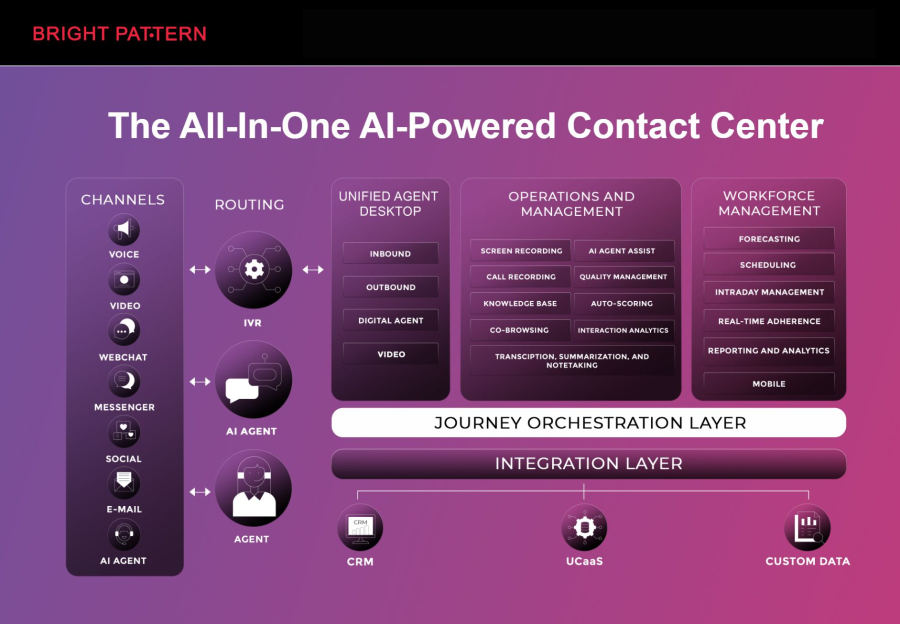
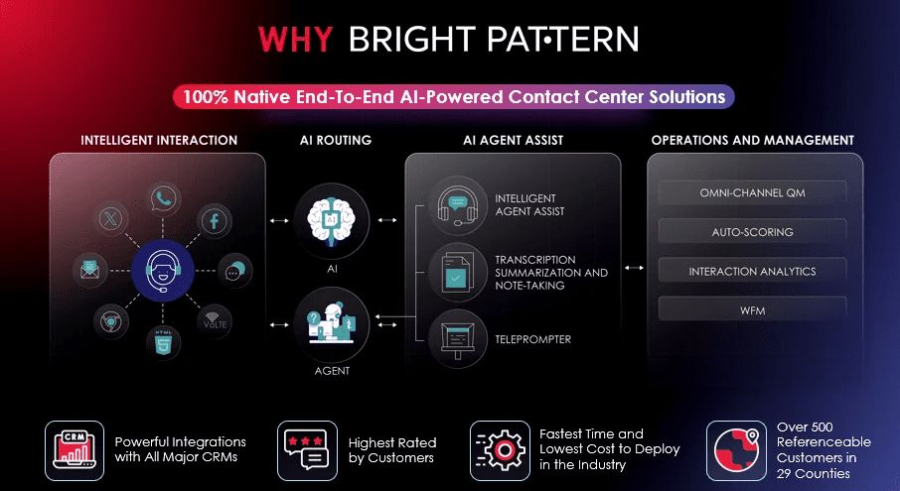
Bright Pattern leads the industry in providing flexible, AI-powered contact center solutions. Its platform integrates ITSM AI to enhance service delivery, automate repetitive tasks, and improve both agent and customer experiences. Key benefits include:
- Omnichannel support: seamlessly connect voice, chat, email, and social media channels.
- AI-driven routing: automatically match inquiries to the right agent based on skills and context.
- Real-time analytics: monitor agent performance and customer satisfaction for proactive improvements.
- Intelligent automation: reduce manual ticket handling and accelerate resolution times.
- Scalable architecture: support growing teams and evolving business requirements effortlessly.
Bright Pattern’s solutions are particularly effective for organizations aiming to implement predictive IT service management, ensuring tickets are resolved before they escalate and enhancing operational efficiency across all departments.
2. Five9 – Cloud Contact Center Solutions
Five9 delivers AI-enhanced contact center software that integrates predictive dialing, intelligent routing, and reporting tools. ITSM AI elements help optimize workflows, ensuring faster response times and improved agent efficiency.
3. Genesys – Customer Experience and AI Integration
Genesys combines AI-driven analytics with omnichannel contact management. Its platform leverages ITSM AI to automate ticket prioritization and provide agents with context-aware suggestions, boosting first-call resolution rates.
4. NICE inContact – AI-Powered Cloud Contact Center
NICE inContact offers AI-assisted routing and real-time analytics that help businesses manage call volume efficiently. The platform’s ITSM AI features enable predictive service delivery and reduce operational bottlenecks.
5. RingCentral Contact Center – Unified Communication AI
RingCentral provides a cloud-based contact center with AI enhancements for chat, voice, and social messaging. ITSM AI integration helps streamline workflows, automate repetitive support tasks, and improve overall customer experience.
6. Talkdesk – AI-Driven Support Platform
Talkdesk focuses on AI-powered automation, enabling service teams to manage tickets efficiently. ITSM AI enables proactive issue resolution, predictive analytics, and personalized customer interactions.
7. Zendesk – AI Customer Support and Ticketing
Zendesk integrates AI to improve support response times and automate ticket workflows. ITSM AI features allow organizations to prioritize critical incidents and provide insights for ongoing service improvements.
8. Salesforce Service Cloud – Intelligent Customer Service
Salesforce Service Cloud leverages AI to help agents resolve cases faster and more accurately. ITSM AI capabilities allow predictive ticket routing and enhanced reporting for smarter decision-making.
9. Freshdesk – AI Contact Center Solution
Freshdesk provides AI-enabled ticketing and omnichannel support. ITSM AI assists in predictive service delivery, automating repetitive tasks, and optimizing agent performance across channels.
10. Avaya OneCloud – AI-Powered Contact Center
Avaya OneCloud integrates AI to support intelligent call routing, self-service options, and predictive analytics. ITSM AI functionality helps reduce service delays and improve customer satisfaction metrics.
What Is ITSM AI?
ITSM AIrefers to the use of artificial intelligence technologies within IT Service Management processes and tools. It enhances traditional ITSM practices with capabilities such as:
- Natural language processing (NLP) to understand user questions written in plain language.
- Machine learning to recognize patterns in incidents, requests, changes, and assets.
- Predictive analytics to forecast demand, detect anomalies, and prevent issues.
- Automation and orchestration to execute routine tasks without human intervention.
Instead of just logging and routing tickets, an AI‑enhanced ITSM platform canunderstandwhat users need,decideon the best action, and oftenexecutethat action instantly.
Why AI Belongs in Modern ITSM
IT environments are more complex than ever: hybrid clouds, SaaS sprawl, constant change, and rising expectations for 24/7 support. AI helps IT teams keep up and stand out by delivering tangible benefits.
- Faster resolutions– AI classifies, prioritizes, and routes tickets automatically, reducing wait times and manual triage.
- Always‑on support– Virtual agents can assist users around the clock, handling routine questions and requests instantly.
- Consistent quality– AI‑driven workflows standardize responses and actions, reducing human error and variation.
- Lower operational costs– Automation removes repetitive work, allowing teams to support more users with the same or smaller headcount.
- Happier users and agents– Employees get quick help; IT staff focus on higher‑value work instead of password resets and status checks.
- Smarter decisions– AI analyzes large volumes of operational data to highlight trends, risks, and improvement opportunities.
Core AI Capabilities in ITSM Platforms
Not every ITSM tool includes the same level of AI, but most AI‑driven solutions focus on several common capabilities. Understanding these will help you identify where you can gain the fastest value.
1. Virtual Agents and Chatbots
Virtual agents are AI‑powered assistants that communicate with users via chat, web portals, or messaging tools. They can:
- Answer frequently asked questions in natural language.
- Guide users through troubleshooting steps.
- Submit and update tickets on behalf of users.
- Trigger automated workflows, such as resetting passwords or provisioning access.
The key benefit is that users receiveinstant, self‑service supportwithout waiting in a queue, while the IT team sees a reduction in ticket volume.
2. Intelligent Ticket Classification and Routing
AI models can analyze the text in an incident or request and automatically determine its category, priority, and the best assignment group. This delivers:
- Faster intake– No more manual selection of categories and subcategories.
- Better routing accuracy– Tickets reach the right team on the first attempt.
- Improved SLAs– Reduced back‑and‑forth reassignment shortens resolution times.
3. Knowledge Management and Semantic Search
AI enhances knowledge management by making it easier to find and use the right information at the right time. Capabilities typically include:
- Semantic search that understands meaning, not just keywords.
- Suggested knowledge articles based on ticket content.
- Automatic article recommendations for both agents and end users.
- Insights into which articles solve issues most effectively.
The result is astrong self‑service cultureand a more knowledgeable service desk.
4. Predictive Analytics and Incident Prevention
AI can analyze historical and real‑time data from ITSM records, monitoring tools, and configuration databases to:
- Detect anomalies and early warning signs of incidents.
- Identify patterns that lead to recurring problems.
- Forecast demand for services and support.
- Suggest preventive maintenance or capacity changes.
This enables IT teams to move from reactive firefighting toproactive, preventive service managementthat protects uptime and user experience.
5. Automation and Orchestration
AI often works hand in hand with automation. While AI decides what should happen, automation engines execute the tasks, such as:
- Resetting passwords and unlocking accounts.
- Provisioning and deprovisioning applications or access rights.
- Running health checks or remediation scripts on servers and endpoints.
- Updating records in the CMDB or asset inventory.
When combined, AI plus automation deliversend‑to‑end, touchless workflowsfor high‑volume, repeatable tasks.
6. Natural Language Understanding for Omnichannel Support
With users contacting IT through email, chat, portals, and collaboration tools, AI uses natural language understanding to:
- Interpret free‑form user messages across channels.
- Extract intent and key details automatically.
- Kick off the right workflow or create structured tickets.
This gives users aconsistent, frictionless support experienceno matter which channel they choose.
Practical AI Use Cases Across the ITIL Lifecycle
AI can enhance nearly every ITIL practice. Here are high‑value use cases that organizations commonly prioritize.
Incident Management
- Virtual agents handle common incidents such as password resets or VPN access issues.
- AI triages incidents by urgency and impact, setting the right priority automatically.
- Suggested resolutions are surfaced to agents based on similar past incidents.
- Clustering algorithms identify major incidents from spikes in related tickets.
Benefit:Reduced mean time to resolution (MTTR)and fewer escalations.
Problem Management
- Machine learning groups related incidents to highlight underlying problems.
- Pattern analysis suggests likely root causes based on history.
- Insights help prioritize problems with the largest business impact.
Benefit:Fewer recurring incidentsand more stable services.
Change Enablement (Change Management)
- AI estimates risk levels by analyzing similar historical changes.
- Predictive models highlight which changes are likely to cause incidents.
- Recommendations help select optimal change windows.
Benefit:Safer, smarter changeswith fewer rollbacks and outages.
Service Request Management
- Virtual agents fulfill standard requests, such as software installs or hardware orders.
- Dynamic forms are pre‑filled using user context and previous behavior.
- Automated approvals and back‑end workflows accelerate fulfillment.
Benefit:Faster, more convenient self‑servicefor routine needs.
Asset and Configuration Management
- AI helps reconcile conflicting asset data from multiple sources.
- Anomaly detection flags unusual configuration changes or usage patterns.
- Predictive models inform hardware refresh cycles and license optimization.
Benefit:Better control of technology costs and risksacross the environment.
Service Level and Experience Management
- AI analyzes SLA performance and highlights where breaches are likely.
- Sentiment analysis on user feedback reveals experience gaps.
- Dashboards combine operational and experience data for a full view of service health.
Benefit:Stronger, more predictable service performancethat aligns with business expectations.
Business Benefits of ITSM AI
AI in ITSM is not only a technology upgrade; it is a strategic enabler for the entire organization. Different stakeholders see different gains.
Stakeholder | Key Benefits from ITSM AI |
Business Leaders | Higher service availability, better employee productivity, and stronger support for digital initiatives. |
IT Directors and CIOs | Optimized costs, improved SLA compliance, and data‑driven decisions about investments and priorities. |
Service Desk Managers | Lower ticket volumes, better first‑contact resolution, and more efficient staffing. |
IT Engineers and Specialists | Less repetitive work, more time for strategic and complex projects, and better visibility into issues. |
End Users and Employees | Faster help, intuitive self‑service, and fewer interruptions to their workday. |
Data, Governance, and Risk Considerations
While ITSM AI offers strong upside, it requires thoughtful governance to stay trustworthy and effective. The good news is that with clear guidelines, you can maximize benefits while controlling risk.
- Data quality– AI relies on accurate ticket, asset, and monitoring data. Investing in clean, consistent data pays off in better recommendations.
- Privacy and security– Ensure AI tools handle personal and sensitive data according to your organization’s policies and relevant regulations.
- Transparency– Document how AI models make key decisions, such as routing or risk scores, so teams can validate and trust outcomes.
- Human oversight– Keep humans in control of high‑impact decisions and allow agents to override AI suggestions when needed.
With these guardrails, ITSM AI becomes areliable partnerthat augments your teams instead of replacing their judgement.
How to Start Your ITSM AI Journey
Implementing AI in ITSM does not have to be a massive, all‑or‑nothing project. You can phase in capabilities and build momentum step by step.
Step 1: Clarify Your Goals
- Define the problems you want AI to solve, such as long resolution times, high ticket volumes, or limited self‑service adoption.
- Align objectives with business outcomes, like improved productivity or reduced downtime.
Step 2: Assess Your ITSM and Data Readiness
- Review your current ITSM processes and tools to identify automation and AI hooks.
- Evaluate data quality, especially incident categorizations, knowledge articles, and CMDB records.
Step 3: Choose High‑Impact, Low‑Risk Use Cases
- Start with repeatable, well‑understood tasks like password resets, simple access requests, or FAQ handling.
- Prioritize use cases with clear metrics, such as average handling time or ticket deflection rate.
Step 4: Pilot, Learn, and Iterate
- Run pilots with a limited user group or specific service area.
- Collect feedback from both end users and support agents.
- Refine AI models, workflows, and knowledge content based on real‑world usage.
Step 5: Scale and Expand
- Gradually roll out successful AI capabilities across more services and business units.
- Introduce additional features, such as predictive analytics or automated remediation.
- Continuously review governance, performance, and user experience.
Key KPIs to Measure ITSM AI Success
Measuring the impact of ITSM AI helps prove value and guide ongoing improvements. Useful metrics include:
- Ticket deflection rate– The percentage of issues resolved via self‑service or virtual agents without human intervention.
- First‑contact resolution rate– How many tickets are resolved in the first interaction, boosted by better triage and knowledge suggestions.
- Mean time to resolution (MTTR)– Average time from ticket creation to closure, often reduced by AI‑driven routing and automation.
- User satisfaction scores– Feedback from surveys and sentiment analysis, indicating improvements in perceived service quality.
- Agent productivity– Tickets handled per agent, or time spent on strategic vs. repetitive tasks.
- Incident recurrence– Frequency of repeat incidents for the same root cause, influenced by AI‑supported problem management.
Future Trends in ITSM AI
ITSM AI is evolving quickly. Organizations that start now will be better positioned to take advantage of emerging capabilities, such as:
- More conversational virtual agentsthat can handle complex, multi‑step interactions in natural language.
- Deeper integration with observability toolsto automate incident detection and response end to end.
- AI‑assisted process designthat recommends optimal workflows based on real usage data.
- Cross‑enterprise service managementwhere AI supports HR, facilities, and finance service desks in addition to IT.
As these trends mature, AI will increasingly act as thecentral intelligence layerfor how services are delivered, monitored, and improved across the business.
Conclusion: Turning ITSM AI into a Competitive Advantage
ITSM AI is more than a technology buzzword. It is a practical way to achieve faster support, higher service quality, and a better experience for everyone who depends on IT.
By starting with clear goals, strong data foundations, and targeted use cases, you can build an AI‑enhanced ITSM capability that:
- Automates routine work and frees IT talent for innovation.
- Delivers responsive, always‑on support to employees and customers.
- Prevents problems before they disrupt the business.
- Provides the insights you need to continually raise the bar on service excellence.
Done thoughtfully, ITSM AI becomes a powerful lever for digital transformation and a clear source of competitive advantage
